Blog / Ford History

Blog

All Ford History Sky Ford Listicles Ford News Sky Ford How-To Guides
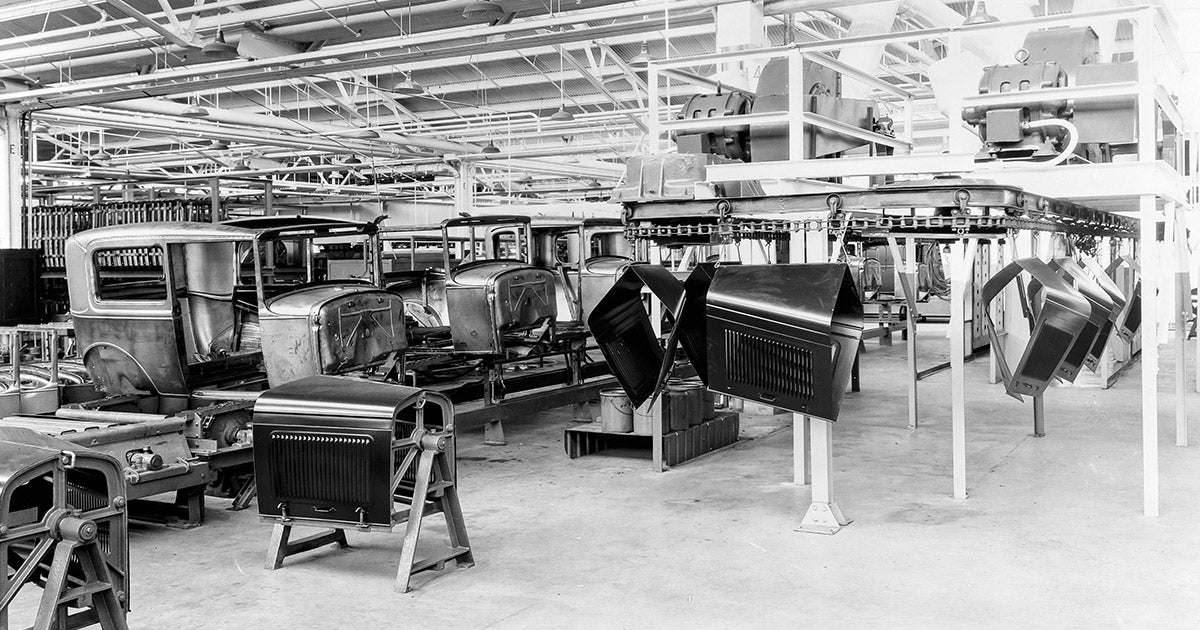
Old Ford factory with parts and sections of old vehicles all around.

Five Ford Innovations that Changed the Game

We all know the story by now. No, Henry Ford didn’t invent the automobile – he merely perfected it to such a degree that he might as well have. That said, the founder of Ford Motor Company didn’t lack for game-changing inventions and innovations. From Henry Ford’s early twentieth century run that established modern practices of mass production and employee benefits, to newer applications such as blind spot technology, Ford has always been at the forefront of cutting-edge thinking. Today, Sky Ford takes a deeper look at the five most consequential ways Ford has changed the landscape of the auto industry. Moving Assembly Line & Mass Production Automobile manufacturing would never be the same following Ford’s implementation of the moving assembly line. By using a conveyor belt, Ford assembly plants were able to efficiently move the product to the worker, rather than having employees scramble around facilities. After much trial and error, the process was perfected at the Highland Park assembly plant in 1913. Soon, new automobiles were being fully assembled in just 90 minutes. In addition, Ford introduced standardization, which reduced production costs and increased efficiency by utilizing standardized parts that could be used on different models. Model T The original game-changer of the auto world. The Ford Model T was mass produced from 1908 to 1927. In that span, it established itself as the first mass-affordable automobile, resulting in car travel becoming available to middle-class America. Thanks to savings stemming from mass production, the average price of the Model T dropped from $780 in 1910 to $290 in 1924 – a truly staggering number when adjusted for inflation. Thanks to the moving assembly line and its interchangeable parts, the Model T (also known as “the Tin Lizzie”) became the most ubiquitous vehicle in the world by an absurd margin. By the early 1920s, more than half of registered automobiles throughout the world were Fords, with over 15 million Model T’s built and sold during that span. $5 Wage / 5-Day Workweek When Henry Ford proposed in 1914 that all Ford employees be compensated at five dollars per workday, it sent a shock wave through the working community – and for good reason. Five dollars per day translates to $153 per day by today’s standards, after adjusting for inflation. That’s good for $19 an hour, well above 2023’s federal minimum wage of $7.25. Then, in 1926, Ford introduced another now-standard workplace practice with the five-day workweek. Though it was driven by the expectation that worker productivity would increase if given more leisure time, Ford also believed giving workers more time to purchase and consume goods would be good for business. The idea passed the test of time; nearly a century later, we’re still looking at ways to further expand on Ford’s vision and bump the workweek down to four days… The Tri-Motor Plane One of the great “What If’s” in automotive history is the Ford Airplane Division, which shut down in 1933 due to the Great Depression. When Ford entered the aviation business during World War I, all they did was introduce the Tri-Motor Plane, an aptly-named, three motor plane that became the United States’ first successful passenger airliner. You can’t help but wonder what Ford could have further accomplished in the aviation space if they hadn’t been forced to cut bait in the 30’s. Unfortunately, in this case, the sky was literally the limit. Blind Spot Monitoring For decades, drivers changed lanes with the aid of three rear mirrors and their own intuition. That changed with the introduction of Ford’s BLIS (Blind Spot Information System). BLIS is responsible for detecting vehicles in your blind spot and alerting you to their presence. It has since paved the way for a plethora of modern collision-avoidance technology. While Volvo was technically the first manufacturer to introduce this feature to the public, Ford’s 1995 concept car, the GT90, was the first vehicle fitted with modern blind spot technology. Ford unveiled its version of blind spot monitoring to a mass audience in 2009 with the 2010 Ford Fusion and Fusion Hybrid. Reinvent Your Driving Future Ford continues to innovate to this day and are currently focused on expanding the reach of EV technology. With plans to put over 40 EVs and hybrid models on the road within the next few years, Ford’s next step seems to be the complete electrification of the majority of its fleet. For instance, at Sky Ford you can check out the Mustang Mach-E, an electric SUV with an EPA-estimated range of 310 miles. But you don’t need to reinvent the wheel before you’re prepared to do so; our Service Center is here to handle all your brake, battery and oil change needs to keep your current ride humming into the new year and beyond.
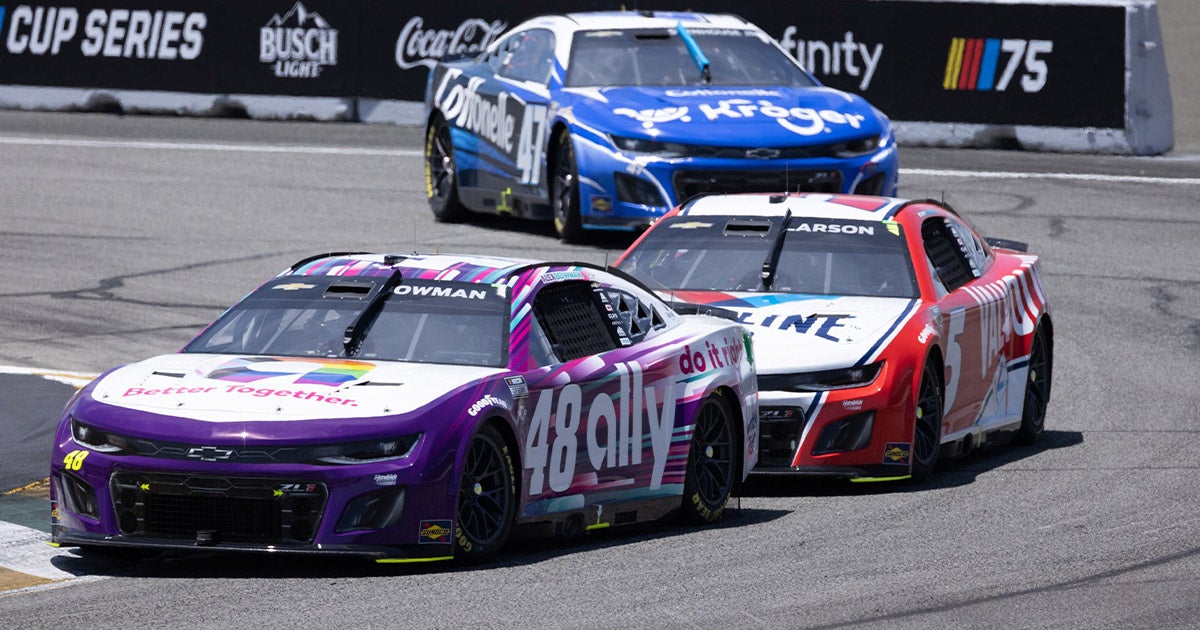
Three NASCAR race cars speed around a track. The leading car is purple with "48 Ally" branding, followed by a red car and a blue car.

Five Landmark Days in Ford’s NASCAR History

It all began in 1901, when Henry Ford stunned the automotive world. In a 10-lap race at the Detroit Driving Club in Michigan, the industrialist defeated the heavily favored, renowned auto designer Alexander Winton. In doing so, Ford’s new company announced itself as a racing line to be reckoned with – nearly a half-century before NASCAR had even assembled. The Ford brand was there at NASCAR’s launch, and throughout the ensuing years, it compiled one of the circuit’s most storied track records. Sky Ford looks back at five pivotal days throughout Ford’s decorated NASCAR history: June 25, 1950: Jimmy Florian wins first NASCAR race in a Ford vehicle. Stock car racer Jimmy Florian’s win at the Dayton Raceway in 1950 was a milestone for two reasons: it marked the first NASCAR victory for a Ford vehicle… and Florian crossed the finish line half-naked. The mechanic-turned-racer cruised past a slew of Oldsmobile drivers en route to capturing the checkered flag. Upon entering the winner’s circle, Florian emerged from his No. 27 Ford in just pants, shoes, and helmet, having torn off his shirt in the middle of the race due to the competitive fire raging inside him (…and also the day’s humidity). The feat earned him the nickname “Shirtless” Jimmy, and caused NASCAR to hastily implement a rule requiring its drivers to remain fully-clothed during races. February 24, 1963: Massive underdog Tiny Lund wins first Daytona 500 for Ford. Lund wasn’t even supposed to be behind the wheel of the No. 21 Galaxy 500 the day Ford captured its first Dayton 500. But the Wood Brothers racing team’s top driver, Marvin Panch, flipped his Maserati sports car during practice for a preliminary race at Daytona, suffering serious (though not life-threatening) burns as a result. One of the mechanics who rushed to rescue Panch from the burning wreckage was DeWayne Louis “Tiny” Lund. From his hospital bed, Panch suggested that Lund serve as his replacement… even though the journeyman was winless in 132 career Cup Series events. Thankfully, the Wood Brothers team devised an expedited strategy that mitigated Lund’s weaknesses. It proved successful (albeit barely), as Lund completed the entire race in one set of tires and made one fewer pit stop than the competition. February 20, 2000: Dale Jarrett wins Ford’s 10 th Daytona 500. Dale Jarrett spent time with various race teams throughout his illustrious, 24-year career – but his longest stint with the same crew was with Ford’s Robert Yates racing team. In 2000, he won his third Daytona 500 and second piloting a Ford, (he’d previously won the 1996 race in his second year on the Yates team). The win also represented Ford’s tenth total Daytona 500 victory, nearly 37 years after Tiny Lund brought home the inaugural win. At the time, Jarrett became just the second driver to win multiple Daytona 500’s in a Ford. (Bill Elliott was a Ford winner in both 1985 and 1987). Matt Kenseth would later tie that mark with wins in both 2009 and 2012. But between those victories… February 20, 2011: Trevor Bayne wins the Daytona 500 for Ford’s 600 th NASCAR victory. Talk about having yourself a day at the race track! Ford took all three podium spots at the 53rd running of the Daytona 500, as rookie Trevor Bayne, Carl Edwards, and David Gilliland finished the race 1-2-3, respectively. Bayne wasn’t even technically allowed to celebrate his win with champagne yet, as he became the youngest racer ever to win the Daytona 500, doing so just a day after his twentieth birthday. With the win, he also nabbed Ford their 600th NASCAR victory. Fair to say, a productive afternoon all around. June 17, 2013: Greg Biffle wins the Quicken Loans 400, Ford’s 1000 th NASCAR win. Though the race itself was just one of many events in NASCAR’s Cup Series in 2013, Biffle’s win marked a major milestone for Ford: 1,000 combined victories in the Sprint Cup, Nationwide, and Camping World Truck Series. Fast forward a decade to the present day, where Ford continues to dominate the NASCAR circuit. The past two Cup Series champions – Joey Logano in 2022 and Ryan Blaney in 2023 – are both members of Team Penske, who fields Ford Mustangs. At this point, you’ve probably come down with a case of racing fever – and the only cure is to get behind the wheel of a sleek, performance-first Ford vehicle today. Race on over to Sky Ford and check out our entire selection of new and used cars, trucks, and SUVs. If you’re already a driver, schedule your next service appointment with us. Whether you need new tires, brakes, or an oil change, Sky Ford boasts the best pit crew in all of Linn County.

Contact Us

Fill out this form below and we'll contact you shortly
*Required Fields